
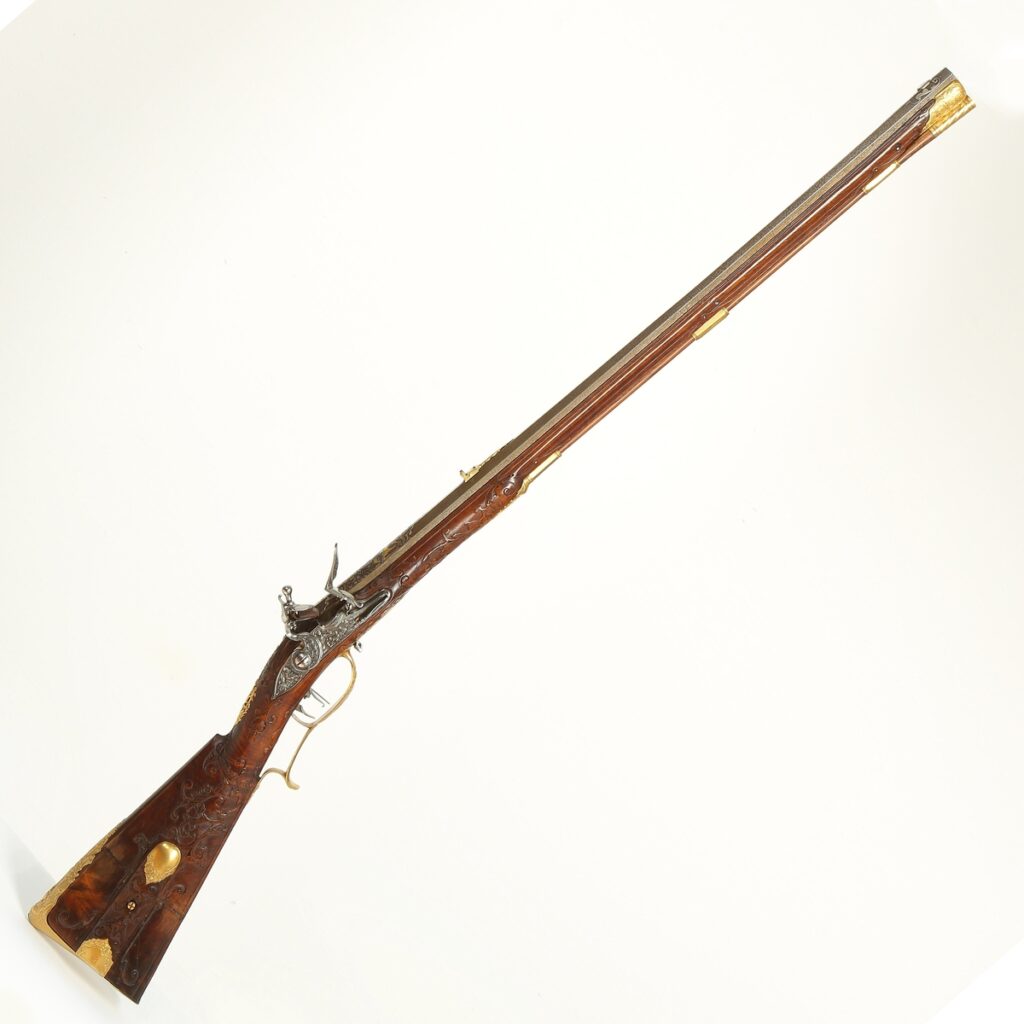
French Flintlock Rifle, S. Hauschka, Wolfenbüttel, c. 1745. Gift by Maria Theresa (1717−1780), Holy Roman Empress and Queen of Bohemia (1740−1780).
Fotogalerie
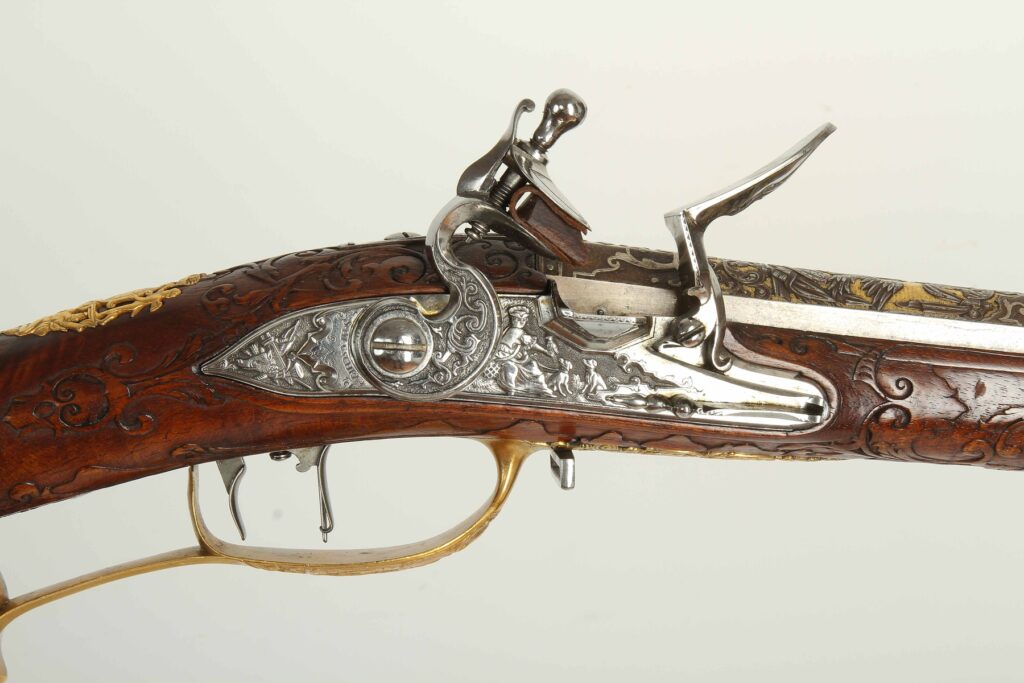
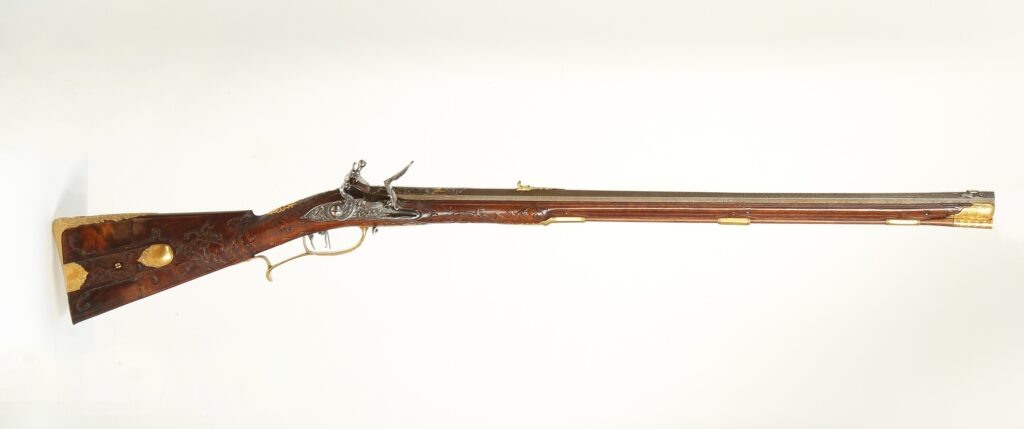
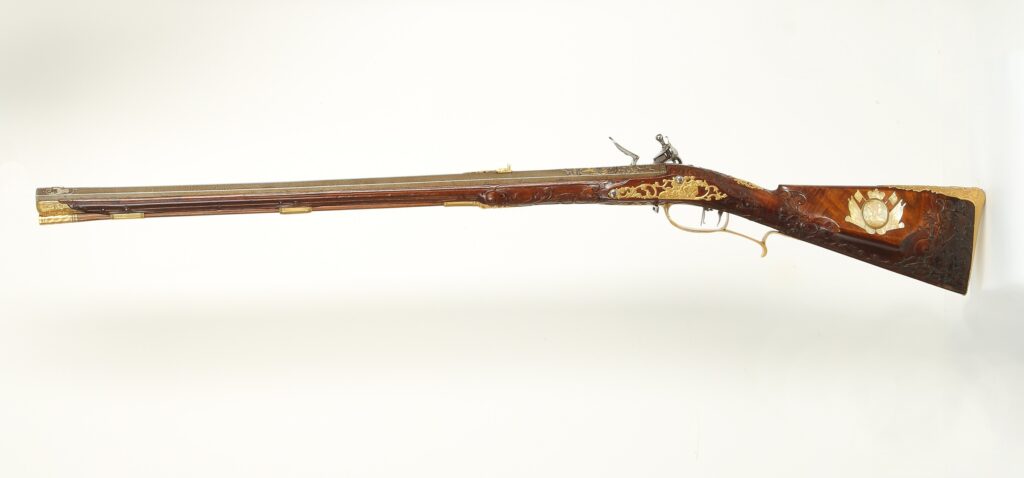
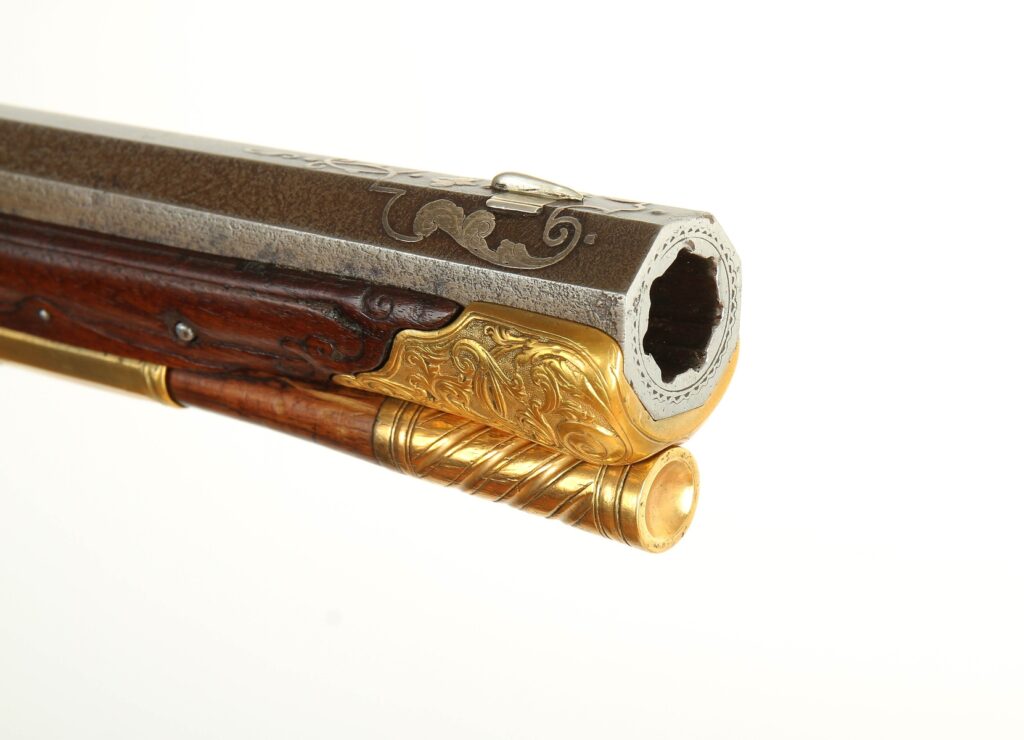
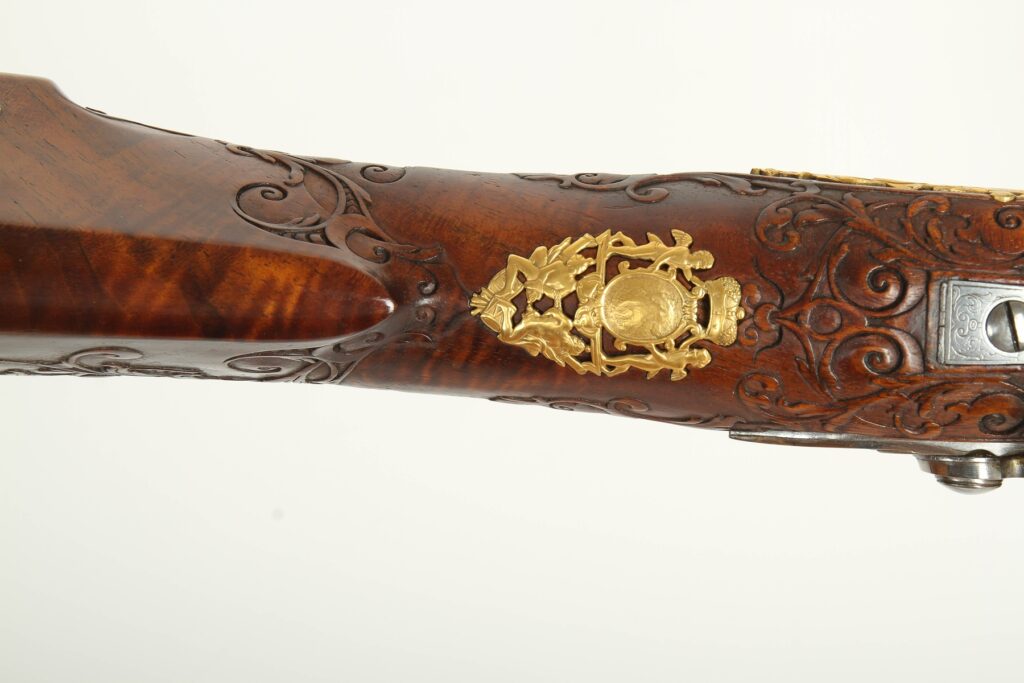
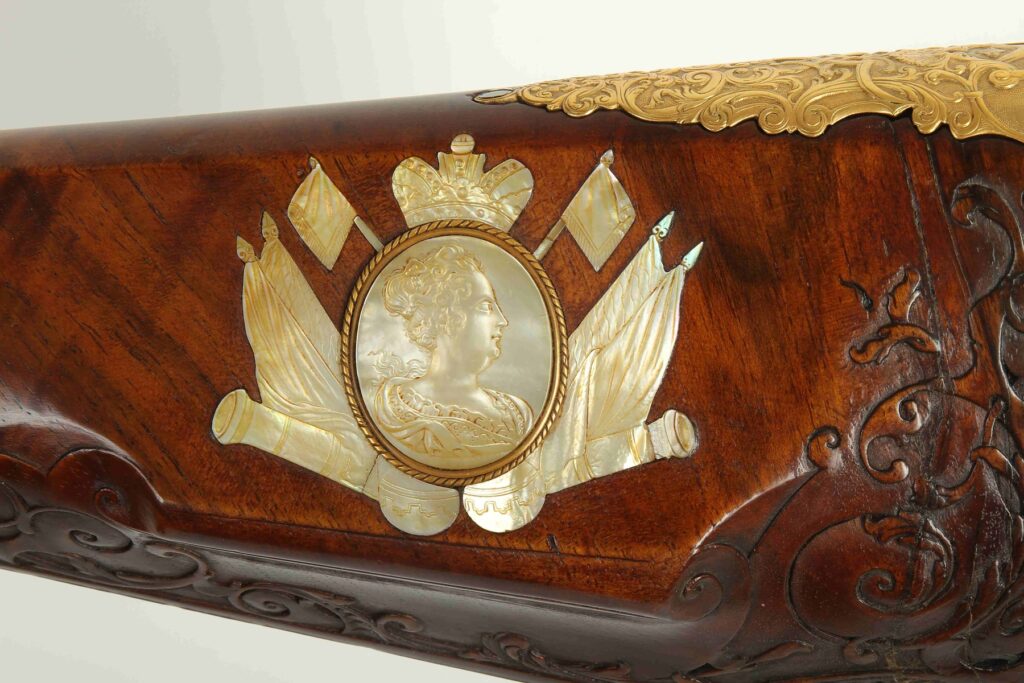
The decorative motifs clearly show that the weapon was intended for a man-soldier or a warrior, or at least for a man who wanted to be perceived as a soldier and a warrior. The dominant decorative element of the stock is a portrait of a woman in her forties, carved from mother-of-pearl and set into the cheekpiece. It depicts a middle-aged Empress Maria Theresa, probably from the first half of the 1850s. This is confirmed by the fact that there are military trophies surrounding the portrait of the Empress. It is consistent with a depiction of an empress who fought to save a monarchy that her neighbours wanted to seize. However, there is also a theory that it is her mother, Empress Elisabeth Christina (1691−1750). According to contemporary portraits, the two women looked very similar at about the age of 40, and there is evidence that Sebastian Hauschka made weapons with their portraits from mother-of-pearl for Empress Elisabeth Christina and her husband, Charles VI. However, Elizabeth Christina does not fit the concept of a woman portrayed as the saviour of the monarchy as she did not save the monarchy, nor did she have to.
Given the fact that the rifle depicts a male warrior and a victor several times, it is highly likely that it was not intended for a female warrior, but for a male victor. It could have been the Empress’s husband, Francis I, someone else from the Habsburg or Lorraine families, or one of the high-ranking people of the Habsburg Army whose monogram or coat of arms was located on the thumb plate. However, the donor of the weapon was undoubtedly Empress Maria Theresa.
Length 1,145 mm, barrel length 750 mm, 15 mm calibre, weight 3,462 g.
Aktuálně
Vojenský historický ústav Praha získal unikátní vlajku z roku 1918
Ministr obrany Jaromír Zůna se zúčastnil konference AOBP a prohlédl si Armádní muzeum Žižkov
Dnes je Mezinárodní den památky obětí holocaustu, připomíná 81 let od osvobození koncentračního tábora v Osvětimi
V Armádním muzeu Žižkov začala programová konference České obce sokolské
Pracovník VHÚ Praha Jiří Rajlich oceněn za celoživotní přínos letectvu a Armádě ČR



Vojenský historický ústav Praha
U Památníku 2, 130 05, Praha 3
muzeum@vhu.cz
Ředitelství
Ředitel VHÚ Praha
brigádní generál Mgr. Aleš Knížek
Sekretariát ředitele
+420 973 204 900
ID DS
hjyaavk
Správní rada pro vyřízení vývozních povolení, darů či výkupů
+420 973 204 903
Správní rada pro vyřízení zápůjček
+420 973 204 900
Veškeré informace týkající se zápůjček exponátů na výstavy a další akce, formuláře pro vývoz milirarií, práva k fotografiím a filmovým sbírkám atd. naleznete v samostatné rubrice Služby veřejnosti.
Knihovna VHÚ
Pracoviště Rooseveltova
+420 973 215 544
Vedoucí knihovny VHÚ
+420 973 215 938
knihovna@vhu.cz
Časopis Historie a vojenství
Šéfredaktor
David Pazdera
+420 973 204 941
Armádní muzeum Žižkov
U Památníku 2
Praha 3 - Žižkov
+420 973 204 924
Letecké muzeum Kbely
Mladoboleslavská ul.
Praha 9 - Kbely
+420 973 207 500
Vojenské Technické Muzeum Lešany u Týnce nad Sázavou
Lešany u Týnce nad Sázavou
pošta Krhanice, 257 42
+420 973 296 161