
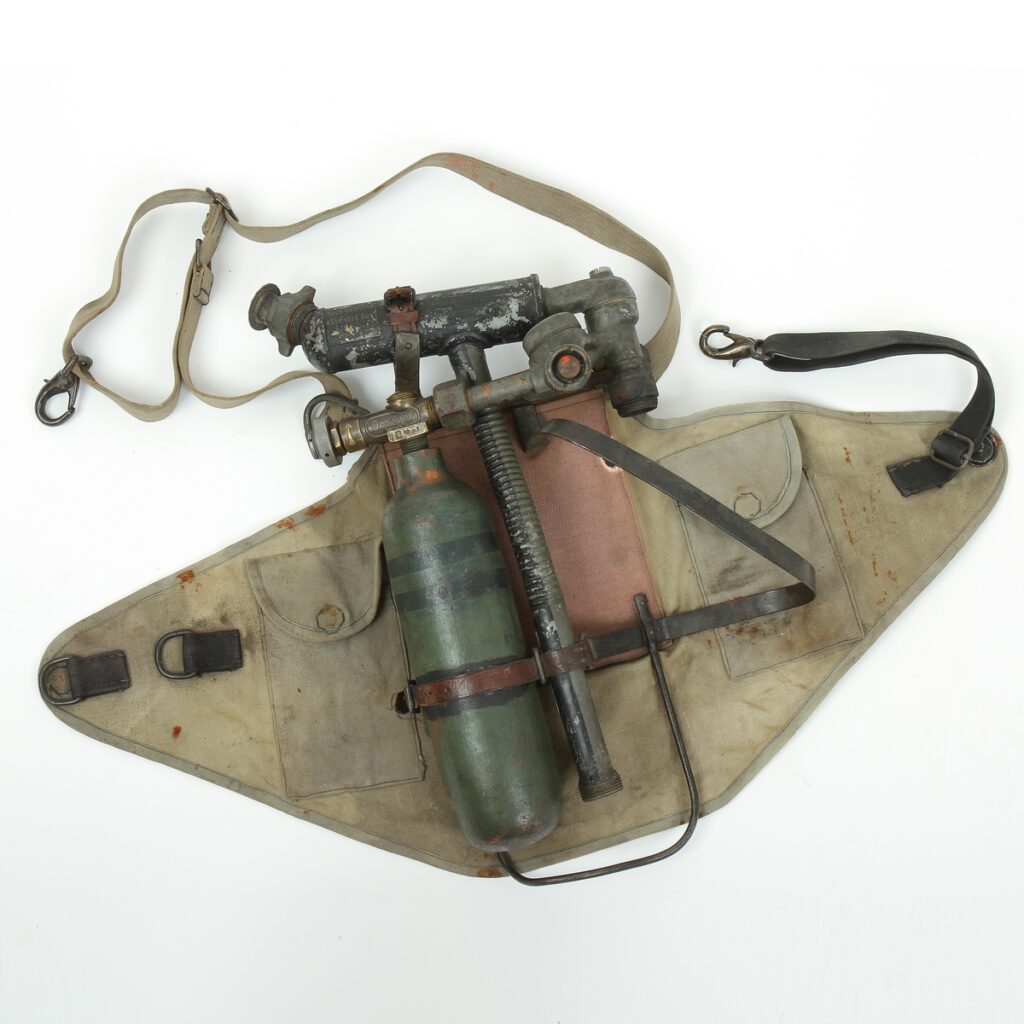
12 German Military Breathing Apparatus Draeger HSS, c. 1916
Fotogalerie
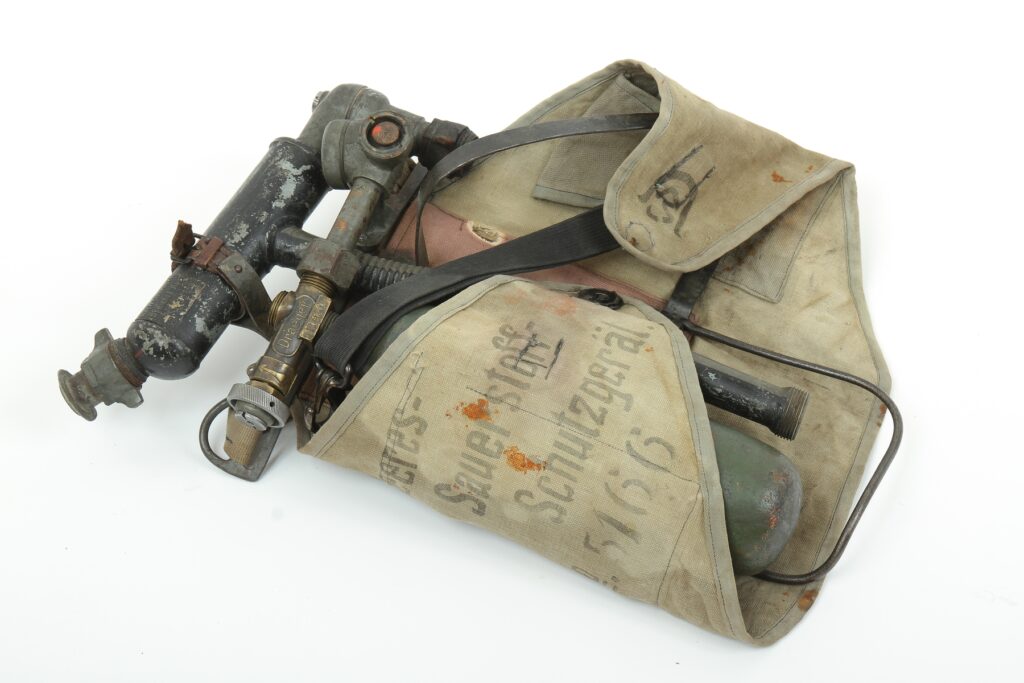
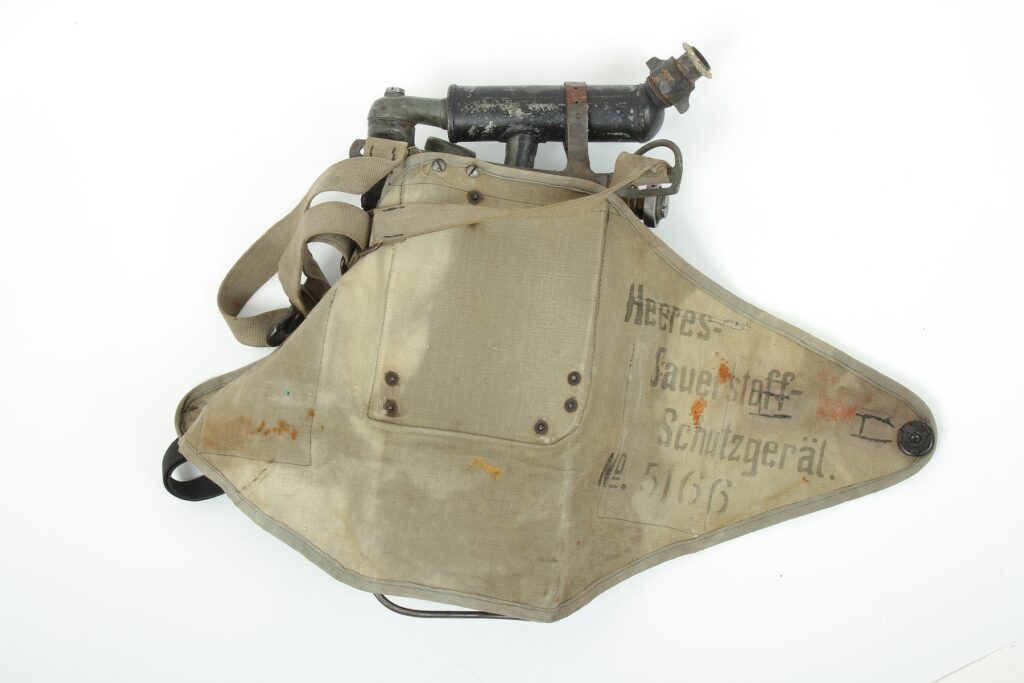
Only the torso of the device has survived, consisting of a steel oxygen cylinder, a valve chamber and a cloth belt used to secure the device to the body.
Protective isolation devices are used in environments where protective masks with filters cannot be used because of the low oxygen concentration in the atmosphere. Oxygen for breathing must be supplied by a device that includes an oxygen storage tank. However, it is also used when the removal of pollutants from the air by filtration is difficult or impossible. These devices were first developed in the mid-19th century for use in mines and by the outbreak of WWI, armies had established designs at their disposal. They could replace, at least initially, protective equipment against certain assault gases and were used even in environments with high concentrations of carbon dioxide (covered, unventilated areas where gunpowder was burned).
In 1916, the German company Dräger in Lübeck developed the Heeres Sauerstoff-Schutzgerät. The device weighed about 7.5 kg and was worn with a belt attached to the side. It consisted of an oxygen cylinder (about 120 litres of compressed oxygen), a valve chamber with inhalation and exhalation valves, an absorber, a breathing bag, guide tubes (cooling tubes and breathing tubes) and a mouthpiece or mask (military protective masks were used). The oxygen supply to the breathing bag was operated by a valve as needed, which required good training and knowledge. The oxygen continued through a cooling tube into the valve chamber. The exhaled air went from the valve chamber to the absorber where carbon dioxide was regenerated, i.e. removed. Trained units could operate this equipment underground and on the surface for up to one hour. Around 16,000 of these were produced for the army during World War I.
Aktuálně
Připomínáme si 78 let od neobjasněného úmrtí Jana Masaryka
Výstava „1945-Voláme všechny Čechy!“ prodloužena do 8. května 2026
V neděli 8. března se v Sokolovu uskutečnil pietní akt
Připomínáme si výročí bitvy u Sokolova - 8. 3. 1943
Připomínáme si 176 let od narození prezidenta T. G. Masaryka





Vojenský historický ústav Praha
U Památníku 2, 130 05, Praha 3
muzeum@vhu.cz
Ředitelství
Ředitel VHÚ Praha
brigádní generál Mgr. Aleš Knížek
Sekretariát ředitele
+420 973 204 900
ID DS
hjyaavk
Správní rada pro vyřízení vývozních povolení, darů či výkupů
+420 973 204 903
Správní rada pro vyřízení zápůjček
+420 973 204 900
Veškeré informace týkající se zápůjček exponátů na výstavy a další akce, formuláře pro vývoz milirarií, práva k fotografiím a filmovým sbírkám atd. naleznete v samostatné rubrice Služby veřejnosti.
Knihovna VHÚ
Pracoviště Rooseveltova
+420 973 215 544
Vedoucí knihovny VHÚ
+420 973 215 938
knihovna@vhu.cz
Časopis Historie a vojenství
Šéfredaktor
David Pazdera
+420 973 204 941
Armádní muzeum Žižkov
U Památníku 2
Praha 3 - Žižkov
+420 973 204 924
Letecké muzeum Kbely
Mladoboleslavská ul.
Praha 9 - Kbely
+420 973 207 500
Vojenské Technické Muzeum Lešany u Týnce nad Sázavou
Lešany u Týnce nad Sázavou
pošta Krhanice, 257 42
+420 973 296 161